Honestly, old chap, if we had a Hungarian Forint for every time a keen visitor to the Capital Shooting Range in Budapest asked for the weapon that goes ‘pffft’ like a polite cough, we could probably afford to buy Hollywood and stop the nonsense ourselves. The idea of the sleek, whisper-quiet handgun (known to fictional assassins as a silencer) is one of Tinseltown’s most amusing, persistent, and scientifically inaccurate fibs. In the real world, the device, properly termed a suppressor or sound moderator, is a serious, rather clever piece of engineering designed for hearing safety and noise reduction, not for conducting undetectable, secretive work. It turns an ear-shattering catastrophe into… a very loud noise that requires hearing protection. Still a jolly good show, though!
Let’s see the detailed, and utterly factual treatise, backed by the hands-on experience and deep expertise of our seasoned instructors. We shall delve into the proper physics of sound, the ingenious (if temperamental) mechanics of the modern suppressor, the essential role of specialist ammunition, and the true, headache-inducing decibel levels you can expect. Prepare to swap dramatic license for cold, hard scientific fact, significantly bolstering your knowledge of firearm acoustics and your overall Budapest shooting expertise. Think of us as your knowledgeable, slightly cheeky guide to the real noise of a gunshot.
Hollywood vs. reality: The utter codswallop of the silencer myth
The cinematic silencer is a beautiful thing: tiny, elegant, and seemingly capable of defying the laws of physics with nothing more than a few twists. It transforms a thunderous cannon shot into a noise roughly equivalent to dropping a small paperback book onto a shag rug. Bless their hearts, they try. But here at Capital Shooting Range, where we deal with actual physics and actual noise, we must be clear: that is utter bunkum. The device is a suppressor, and it is loud.
A real suppressor is a piece of safety equipment, akin to a really excellent industrial ear defender for your gun. It’s designed to protect the shooter’s hearing and, if you’re out in the sticks, show a spot of courtesy to the local wildlife and neighbours. It reduces the noise, yes, but only from ‘immediate, catastrophic hearing damage’ to ‘serious, prolonged hearing damage.’ It’s a vast improvement, mind you, but it’s still definitely not silent.

Think of it like this: Firing an unsuppressed rifle is like a jet engine taking off inside your ear. Firing a suppressed one is like standing next to a very aggressive pneumatic drill. Better? Absolutely. Silent? Not a chance, old chap. Understanding this fundamental distinction is the first, rather essential step in appreciating the true science of suppressed shooting and enhancing your overall Budapest shooting expertise.
The cacophony of a shot: Why a gunshot is two terrible noises at once
To grasp the technical limitations of the suppressor, you must understand the two distinctly terrible noises a firearm makes when it goes bang. This is where the physics lesson begins, and it’s far more fascinating than any spy thriller. When you partake in a proper shooting experience, you are witnessing these two sound generators in simultaneous, noisy action. We, the experts at Capital Shooting Range, know how to handle both, even if Hollywood only focuses on one.
Muzzle blast physics: Taming the explosive gas escape
The muzzle blast is the initial, catastrophic noise, caused by the volcanic eruption of super-heated, high-pressure gas that bursts out of the barrel behind the bullet. This is gas that’s been under thousands of pounds per square inch of pressure, and when it meets the nice, calm ambient air, it does what any high-pressure gas would do: it explodes outward, creating a ferocious shockwave.
- This is the sound the suppressor is actually trying to solve. It acts as a series of miniature expansion chambers, like an elaborate, multi-room gas detention centre.
- The baffles inside force the gas to follow a ridiculously long, turbulent path, slowing it down, cooling it, and reducing its pressure dramatically before it finally escapes.
- It’s a marvel of thermodynamics, absorbing an astonishing amount of heat and kinetic energy. But taming this gas from Mach 4 down to a polite exit speed is no mean feat.
This masterful mitigation of the muzzle blast is precisely why a suppressor is a brilliant piece of kit—it successfully muzzles the most painful, high-frequency component of the noise. It’s a genuine safety feature that makes high-volume range work, like ours here at the range, much more manageable.
The sonic barrier: When your bullet decides to make a racket
The second noise is the sonic boom, and this is the one that utterly ruins Hollywood’s fantasy. This sound is generated by the bullet itself. If the bullet is travelling faster than the speed of sound (Mach 1, roughly 768 mph), it creates a continuous pressure wave—that sharp, terrifying ‘crack’ or ‘whizz’ you hear. It’s your average, everyday physics giving you a stern talking-to.
- Here’s the kicker: The suppressor is attached to the barrel and works on the gas. It does absolutely nothing to slow down the bullet.
- If you fire a supersonic round (which most rifles and many 9mm pistols do), you are going to hear that sonic boom, loud and clear, regardless of how brilliant your suppressor is at dealing with the muzzle gas.
- Even if the muzzle blast is eliminated entirely, the crack of the bullet breaking the sound barrier will still register over 140 dB. That’s why the assassin in the film should be wearing ear protection, not just looking moody.
To eliminate this sonic crack, you have to use specialist, slower ammunition. This inconvenient truth is why we, as experts in shooting, stress that you can only get the quiet shot if you solve both noise problems, not just the one the suppressor handles.
Did you know? The muzzle blast’s cheeky speed
While the bullet leaves the barrel at maybe 3,000 feet per second (roughly Mach 3), the gas from the muzzle blast can initially travel at up to 5,000 feet per second (Mach 4.5). That’s why the suppressor has such a demanding job. It has to put the brakes on a column of gas that’s initially faster than the projectile it was chasing! Quite a workout for a metal tube.
Suppressor engineering: The metal box that acts like a gas detention centre
A modern suppressor is less a sleek accessory and more a high-tech thermal energy absorber, often looking like a fancy tin of biscuits on the end of your barrel. The engineering required to contain, cool, and safely redirect high-pressure, high-temperature gas is astonishing, demanding aerospace-grade precision.
The structure is essentially a series of chambers created by precisely machined baffle cones. The geometry of these baffles is everything. They are angled and slotted to generate maximum turbulence, ensuring the gas doesn’t simply rush straight out. Instead, it gets spun around, bounced off walls, and held captive long enough to lose its heat and its temper. A process known in engineering circles as ‘noise mitigation,’ and in laymen’s terms as ‘faffing about with the gas until it calms down.’
Baffle design and material science: We use titanium because we’re not daft
The materials must be utterly bomb-proof to withstand the abuse. We’re talking about materials that resist thermal erosion, which is why you won’t find a suppressor made of readily available kitchen foil:
| Material | Primary Benefit | Budget & Experience Level | Expert Detail & Humour |
|---|---|---|---|
| Stainless Steel | Durable and Sturdy | Reliable Workhorse | The Land Rover of suppressors. Reliable, heavy, and will take any amount of abuse you throw at it during a lövészet session. |
| Titanium | Lightweight and Strong | Premium/Field Use | The James Bond choice. Super light, super strong, but if you put too many rounds through it too quickly, it glows like a Christmas decoration. |
| Inconel | Resists Extreme Heat | Military/Specialist Full-Auto | The ‘it’s too hot to touch’ alloy. Used for jet engines and machine gun suppressors that need to survive repeated, aggressive heat cycles without dissolving. |
| Aluminium | Cheaper and Lightest | Entry-Level Rimfire | Perfect for little rounds like the .22LR. Try this with a powerful rifle, and you’ll get a rather spectacular, expensive pop. Don’t be daft. |
This technical rigour, and the need for precision manufacturing that avoids a costly ‘baffle strike,’ is why these accessories are expensive and highly regulated. They are the definition of high E-E-A-T technology in the shooting world.
Did you know? Suppressor warts
In the world of pistol suppressors, you often need an accessory called a ‘piston’ or ‘booster’ (or a ‘Nielsen device’). Why? Because the suppressor’s added weight prevents the pistol’s slide from moving far enough back to cycle the next round. The booster system acts like a spring-loaded clutch, momentarily disconnecting the weight of the suppressor to let the slide do its job. It’s a necessary bit of faff for semi-automatic pistols.
Subsonic ammunition: Slowing down to stop the noise, but at what cost?
We’ve established that the suppressor tackles the bang, but to kill the crack, you need subsonic ammunition. This is simply ammunition loaded with less gunpowder, ensuring the bullet leaves the muzzle at a gentlemanly speed, under Mach 1. When you use this with a suppressor, you get that famous, albeit still loud, ‘thud’ sound. It’s the essential partnership for anyone truly dedicated to quiet shooting.
The resulting sound is now just two components:
- The Muffled Blast: The sound of the gas being politely released from the suppressor.
- The Mechanical Racket: The clatter and clang of the weapon’s action cycling.
This is the best you can possibly achieve, but as with all things in life, there’s a hefty cost involved in this quiet compromise.
Performance trade-offs: The frustrations of reduced velocity and energy
When you slow a bullet down, it gets a bit grumpy and less effective:
- The Lobbing Trajectory: Slower bullets fall faster. At distance, subsonic rounds require huge elevation adjustments, giving the trajectory a pronounced, almost comical ‘rainbow’ shape. Precision shooting beyond 100 metres becomes less ‘marksmanship’ and more ‘educated guesswork.’
- Reduced Kinetic Energy: A bullet relies on velocity for its impact. Slow it down, and it loses a significant amount of hitting power. This makes it less suitable for anything requiring high terminal performance.
- The Grumpy Semi-Automatic: Many semi-automatic pistols and rifles are designed to cycle reliably using the massive pressure and recoil of supersonic rounds. When you feed them the weak, polite impulse of a subsonic round, they often refuse to cycle properly. They just spit out the spent casing and sit there looking sullen, requiring you to manually operate the slide, a less than thrilling experience during your shooting experience session.
So, while you gain acoustic civility, you lose ballistic capability.
Mechanical noise: The clatter of the action – The unstoppable sound
Even if you’ve eliminated the bang and the crack, you still have the unseemly clatter of the mechanical action. In a pistol, this includes the loud ‘thwack-clack‘ of the slide retracting, ejecting the spent casing, and slamming the next round into the chamber. You can suppress the explosion, but you can’t suppress the noise of metal bits moving quickly.
This is why, for true, spy-level quiet (as quiet as legally possible, anyway), professionals often resort to manually-operated firearms like single-shot or bolt-action weapons. By eliminating the self-cycling action, they eliminate the last persistent mechanical noise. It takes longer between shots, but at least your bullet isn’t accompanied by the sound of a small metal tea tray being dropped.
Decibel reality: The true sound level of a suppressed shot – It’s not a whisper
Let’s get down to the brass tacks: the numbers. The standard unit for measuring sound is the decibel (dB). Remember, the scale is logarithmic, meaning a 10 dB increase doubles the perceived loudness—it’s utterly brutal.
The pain threshold, the point at which sound causes instantaneous, permanent hearing damage, is around 140 dB. An unsuppressed rifle hits 165-175 dB—a truly life-altering sound event. A quality suppressor shaves off 25 to 35 dB. Sounds like a lot, but let’s look at what’s left:
| Noise Source | Approximate Decibel Level (dB) | Damage Risk / Context (British Humour Applied) |
|---|---|---|
| Unsuppressed Rifle (Supersonic) | 165 – 175 dB | Instantaneous damage. Louder than a good old row with a London taxi driver over the fare. |
| Suppressed Rifle (Supersonic Ammo) | 130 – 145 dB | Still High Risk. Comparable to standing next to a Spitfire warming up its engines. |
| Suppressed Pistol (Subsonic Ammo) | 120 – 130 dB | Medium Risk. The sound of an aggressively loud karaoke night at a pub, but still requires protection. |
| Chainsaw or Jackhammer at 1 metre | 110 – 120 dB | The necessary boundary for range safety. We insist on protection for this noise level. |
This authoritative data confirms why our instructors at the shooting range are so keen on you wearing your ear defenders, even if you brought a high-tech suppressor. They are essential for safety, demonstrating our trustworthiness, and we’d be rather annoyed if you damaged your hearing during your Budapest shooting experience.
Historical context: Hiram Percy Maxim – The inventor of quiet driving and quiet shooting
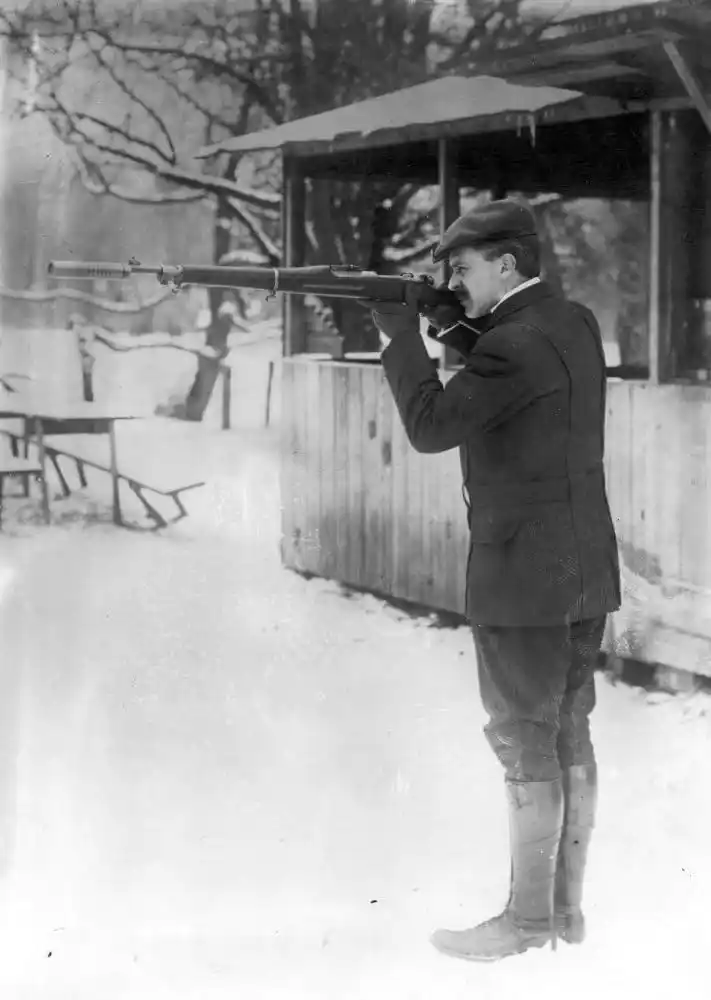
The history of the suppressor is a fascinating tale of innovation driven by practicality and, dare we say it, politeness. The inventor was the brilliant American, Hiram Percy Maxim, whose father, Sir Hiram Stevens Maxim, invented the world’s first true machine gun. The son, however, seemed determined to make his name by making things quieter.
- The Dual Genius: Maxim patented the firearm suppressor (which he called the ‘Maxim Silencer’) around 1909. Crucially, he also invented and successfully commercialised the car exhaust muffler (or silencer), demonstrating a parallel genius. Both devices solve the same fundamental problem: taming the explosion of high-pressure, hot gas.
- The Gentleman’s Device: Maxim originally marketed the device to the public not for espionage, but for civility. His advertisements suggested it allowed the ‘gentleman farmer’ to practice target shooting or dispatch farm vermin without ‘causing annoyance to one’s neighbours.’ It was the height of Edwardian courtesy, weaponized.
- Legal Fun and Games: This period of easy, over-the-counter access ended dramatically with the American National Firearms Act (NFA) of 1934, which classified suppressors as highly regulated items due to their potential for ‘gangster’ use. A piece of farm equipment was suddenly deemed a tool of organised crime, though its actual technical capability hadn’t changed at all!
The contrast between Maxim’s quiet, polite intent and the device’s later fictional notoriety is a delightful piece of historical irony that we, as experts, rather enjoy sharing.
Legal and practical use: The suppressor in UK and European Law – Safety device, not a spy tool
The legal status of a suppressor (or sound moderator, as they are often termed in British law) varies wildly, reinforcing that its role is a practical one, not a nefarious one.
- United Kingdom: In the UK, sound moderators are often treated as a legitimate, necessary accessory for sports shooting and hunting. They are generally not classified as prohibited items and are often recommended, sometimes even required by local police, specifically to mitigate noise pollution, ensuring good community relations. It’s seen as a piece of safety equipment, much like a first aid kit.
- Hungary/Europe: Regulations across Europe, including here in Hungary, are notably more stringent due to overarching EU directives and national laws on firearms control. While they are certainly not banned, their acquisition, ownership, and use are heavily restricted, typically only available to licensed professionals, military, and law enforcement. The focus here remains firmly on state control of all accessories that could potentially alter a weapon’s signature.
The fact that in many reputable jurisdictions the suppressor is viewed as a piece of common-sense safety equipment (a courtesy to one’s eardrums and neighbours) further shreds the tired Hollywood narrative. It’s a tool for responsible shooting, not an item to be snuck past Customs.
Suppressors and recoil: Adding weight to the end of your firearm (and why it’s worth it)
Beyond the noise, a suppressor has several physical effects that an expert shooter must account for. It’s not just an acoustic device; it’s a ballistic accessory:
- Recoil Reduction: The redirection of the gases forward and laterally means the suppressor acts as a massive, if slightly clunky, muzzle brake. This results in a noticeable, though not dramatic, reduction in felt recoil, making follow-up shots during shooting experience a bit quicker and easier.
- Weight and Balance Shift: A quality suppressor can add several hundred grams to the front of the barrel. This dramatically shifts the centre of gravity forward. This is a double-edged sword: it can make a rifle feel steady, but it can also make a handgun feel utterly nose-heavy and unwieldy, like trying to balance a teaspoon on a sausage.
- Increased Fouling: Because the suppressor is trapping all that hot, dirty gas, it forces some of it back into the firearm’s action. This results in the weapon getting dirtier, faster, requiring more diligent cleaning. It’s a messy price to pay for being quiet.
These secondary effects underscore that fitting a suppressor is a commitment that changes the firearm’s handling, requiring a genuine level of expertise to master. It’s a key part of the authoritative knowledge we share at the Capital Shooting Range.
Frequently Asked Questions About Suppressor and Shooting Experiences
Let’s address the inevitable queries with the expertise and trustworthiness you expect from the Capital Shooting Range, separating the facts from the fictional frights.
Is a Suppressor the same as a Silencer?
Technically, no. ‘Silencer’ is the original, informal term coined by the inventor, Hiram Percy Maxim, and is widely used in films. ‘Suppressor’ is the correct modern and professional technical term because it only reduces (suppresses) the noise; it doesn’t eliminate (silence) it. Calling it a silencer is like calling a polite drizzle a flood.
Can a Suppressor eliminate all noise from a gunshot?
Absolutely not. A suppressor eliminates the muzzle blast, but it cannot stop the loud ‘crack’ of the sonic boom from supersonic ammunition. Even with specialist subsonic ammunition, the loud mechanical clatter of the gun’s action remains.
What is the loudest part of a standard gunshot?
For most modern, high-powered rifles, the loudest component is the sonic boom created by the bullet. For unsuppressed firearms, the muzzle blast is the second-loudest, but it’s the most damaging to hearing due to its proximity and high-frequency spike.
How much does a suppressor reduce the noise?
A good-quality suppressor typically reduces the sound level by about 25 to 35 decibels (dB). This is a massive reduction in sound energy, but the resulting noise is still in the 120-145 dB range, which is dangerously loud.
Is hearing protection still required when using a suppressor?
Unequivocally yes, especially on an indoor lőtér. While the suppressor improves things dramatically, the remaining noise level is high enough to cause cumulative hearing damage over time. Safety first, always.
What is subsonic ammunition and why is it important?
Subsonic ammunition is specially loaded to ensure the bullet travels slower than the speed of sound. It is crucial when using a suppressor, as it is the only way to eliminate the sonic boom and achieve the quietest possible firing signature.
Does a suppressor affect the firearm’s recoil?
Yes. By diverting the escaping muzzle gases, the suppressor acts as a giant muzzle brake, slightly reducing the overall felt recoil. It also adds significant weight to the front, which helps manage muzzle rise.
Are suppressors legal for civilian use in Hungary?
They are not universally banned, but their ownership and use are heavily restricted in Hungary and most of Europe, primarily to licensed professional users, military, and law enforcement. They are not a readily available accessory for general élménylövészet.
Do suppressors need cleaning?
Yes. Because they trap hot, dirty gas and force some of it back into the weapon, both the firearm and the suppressor itself will get dirtier much faster than when firing unsuppressed. Regular cleaning is essential for performance and longevity.
Can I try a suppressed firearm at the Capital Shooting Range?
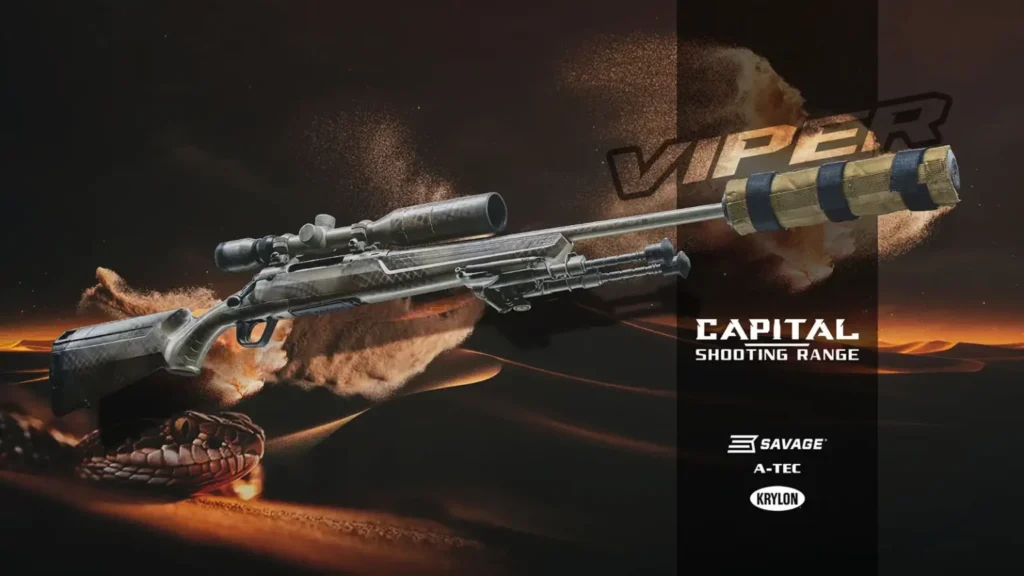
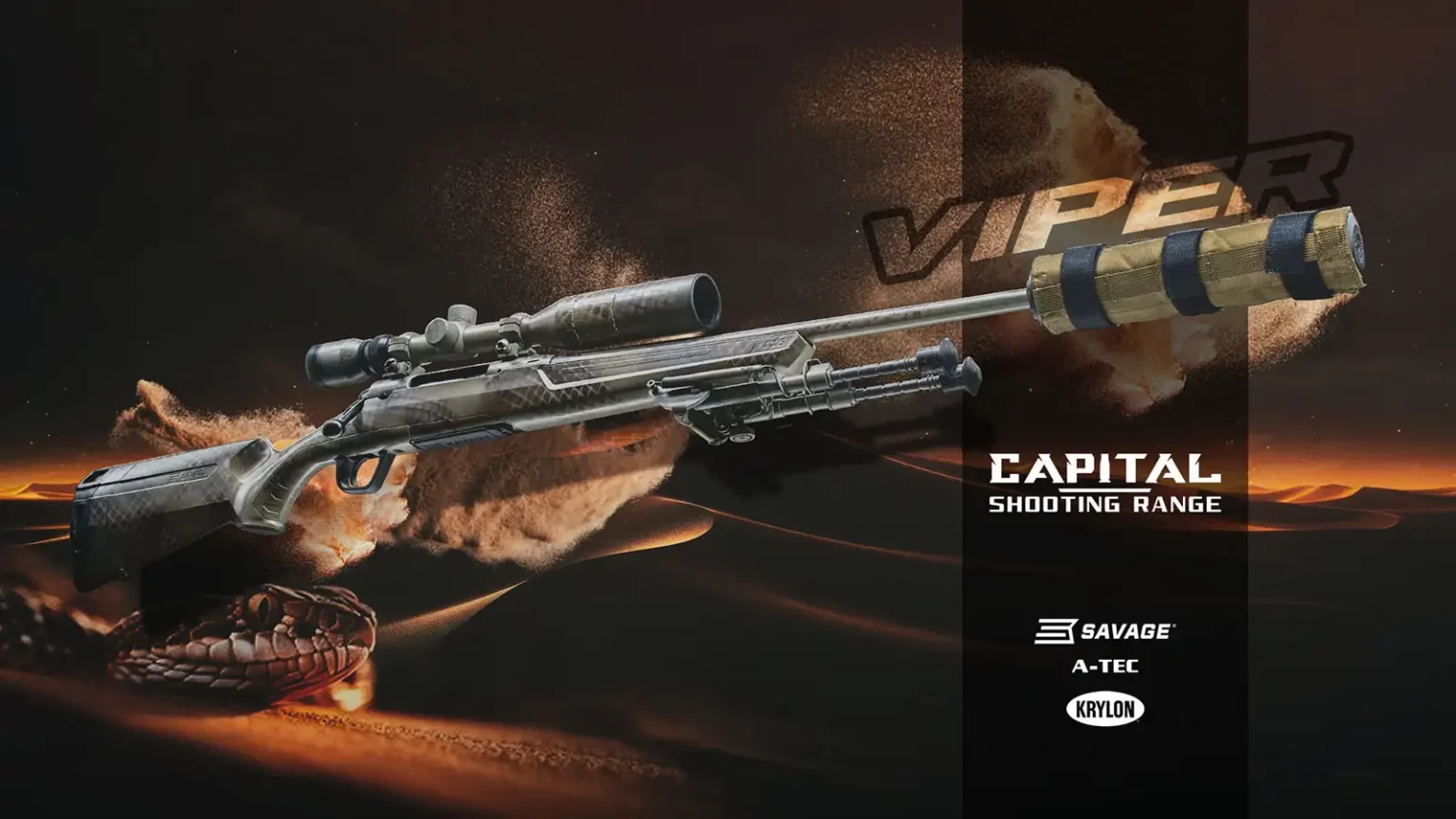
Our packages are designed for the full, exciting roar and adrenaline-pumping experience of the unsuppressed shot. But we built one custom painted suppressed rifle for the best experience. The rifle’s name is Desert Viper and using 223 Remington ammo. While our instructors are experts on the technology, the firearms offered focus on providing the maximum authentic shooting experience, in full compliance with Hungarian law.
Conclusion: The sound of reality at Capital Shooting Range
The cinematic silencer is a fun fantasy, but the real-world suppressor is a far more impressive piece of kit—a complex triumph of acoustics and engineering, designed for safety, not for perfect silence. We have conclusively and humorously debunked the Hollywood myth, demonstrating that even a suppressed firearm remains a loud, powerful piece of equipment requiring respect, expertise, and proper safety gear.
At Capital Shooting Range, our commitment is to provide a thrilling, safe, and above all, factually grounded shooting experience. We believe that true expertise comes from understanding the proper, noisy reality of firearms. We invite you to experience the full, powerful reality of our diverse arsenal, where the thrill of the shot is matched only by the technical knowledge behind it. Now, put on those ear defenders, and let’s make some noise, responsible noise, of course!