For many tactical enthusiasts in the UK, the “John Wick” dream often ends at the check-in desk of a budget airline heading to Budapest or Prague. The reality of the UK’s 1997 handgun ban means that practicing rapid-fire, multi-target pistol transitions with a 9mm is a legal impossibility for most. However, in 2026, a high-octane alternative has taken center stage: IPSC Action Air.
Action Air is not “just airsoft.” It is a formally recognized international shooting discipline governed by the UKPSA (United Kingdom Practical Shooting Association). It utilizes the same rules, the same stage designs, and the same rigid safety protocols as live-fire practical shooting, but swaps gunpowder for high-pressure gas. If you want to keep your skills sharp in London, Manchester, or Birmingham, this is the most authentic bridge to professional tactical shooting available today.
The “Action Air” bridge: DVC in 2026
The core philosophy of Action Air is DVC (Diligentia, Vis, Celeritas)—Accuracy, Power, and Speed. While the “Power” element is simulated through the calibration of metal “Popper” targets, the Accuracy and Speed requirements are identical to those found at the World Shoot.
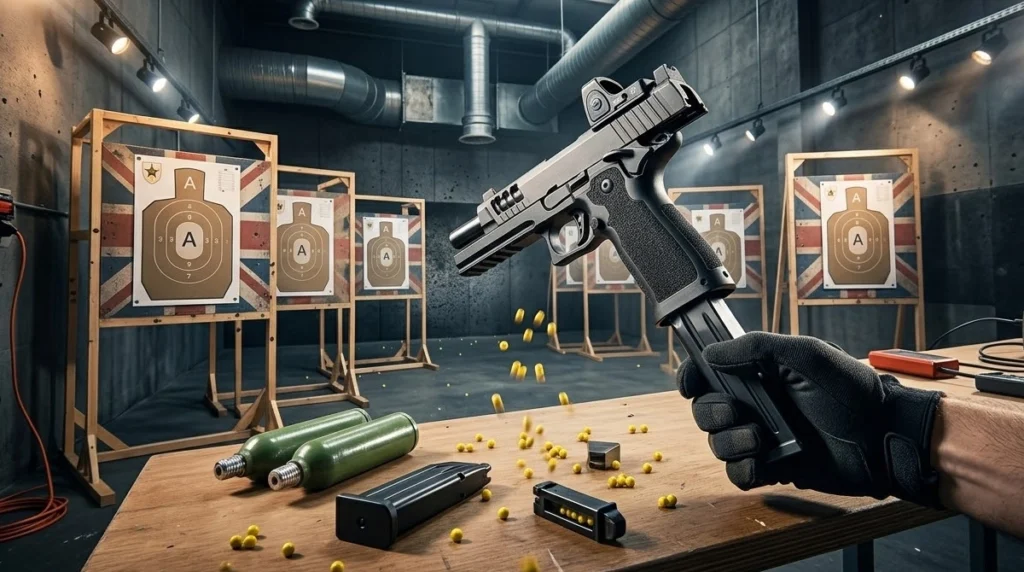
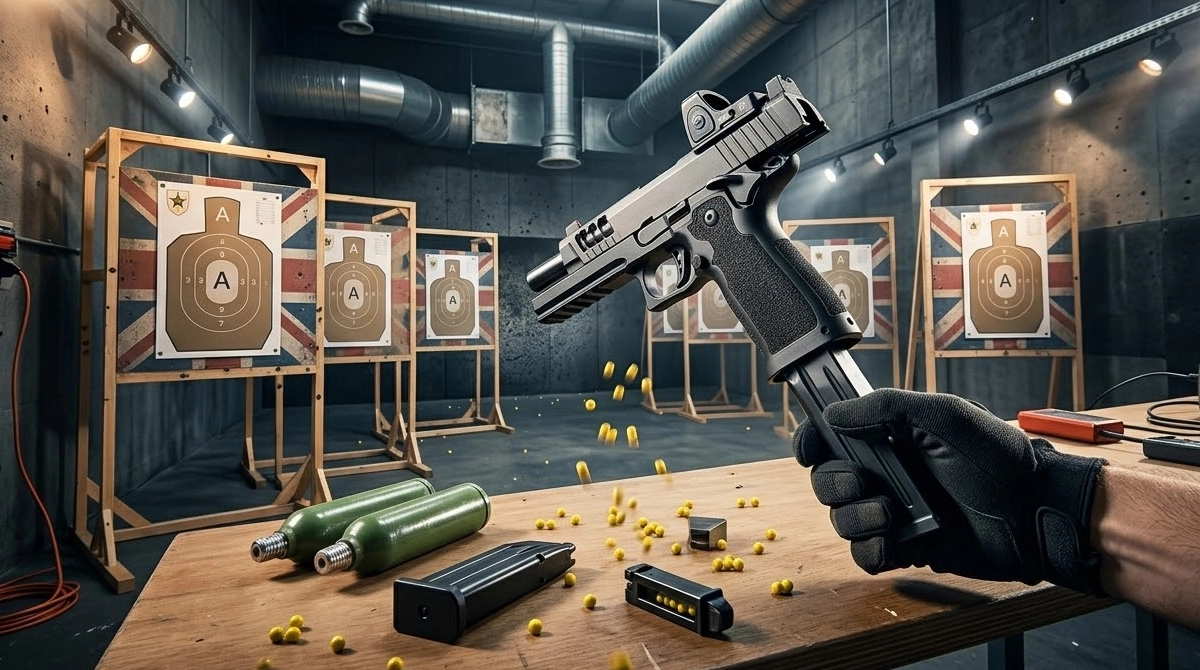
For the tactical shooter, the magic lies in the Gas Blowback (GBB) platform. Unlike standard airsoft “toys,” a competition-grade GBB pistol provides:
- Recoil Management: The slide cycles violently with every shot. While it doesn’t have the “kick” of a .45 ACP, it provides enough muzzle flip to require a proper grip and sight tracking for follow-up shots.
- Mechanical Fidelity: From the functioning grip safeties of a 1911 to the trigger reset of a CZ Shadow 2, these replicas are 1:1. This means your high-end Safariland or Ghost holsters will work exactly as they do on a live range.
- Last-Round Lock: Training for the “slap-and-rack” reload is vital. In Action Air, when your magazine is dry, the slide locks back, demanding a high-speed magazine change under the pressure of the shot timer.
The professional circuit: UKPSA divisions
Just like its live-fire counterpart, Action Air is highly categorized. In 2026, the UKPSA holds Level 1, 2, and 3 matches across the country. Your choice of equipment dictates which Division you compete in:
1. Production division
The most popular entry point. This is for “out-of-the-box” service pistols like the Glock 17, Sig P320, or CZ Shadow 2. Modifying the internal triggers or adding external weights is strictly prohibited. It’s all about the shooter’s skill, not the depth of their wallet.
2. Standard division
Think of this as “Production Plus.” You can add flared magwells for faster reloads and modified grips. However, the gun must still fit inside the “IPSC Box” (a set of dimensions to ensure the gun remains a practical size). It’s the sweet spot for the serious hobbyist.
3. Open division: The “Formula 1” of shooting
In the Open Division, anything goes. Huge “Big Stick” magazines holding 28 rounds, frame-mounted red dot sights, and massive compensators. While these guns look sci-fi, they allow for the fastest stage times in the sport. If you want to see what a human is truly capable of with a pistol and a timer, this is it.
4. Classic division
Reserved for the purists. This division is strictly for 1911-style single-stack platforms. With a 10-round magazine limit, your stage planning and reload timing must be flawless to succeed here.
Stage planning: The mental game
Practical shooting is often described as “chess with a gun.” In an Action Air match, you are presented with a Course of Fire (CoF) containing anywhere from 8 to 32 targets. You are not told how to shoot it; you must decide your own “Stage Plan.”
- Target Arrays: Which targets can you see from this window? Should you shoot the moving swinger first or the static paper?
- Reload Points: Can you make it to the next barricade before you run dry? A “standing reload” (reloading while not moving) is a cardinal sin that costs precious seconds.
- The Stop Plate: Every stage ends with a specialized electronic plate. When your final BB hits it, the timer stops. If you miss the stop plate, your time keeps running—the ultimate pressure test.
The transition: From Budapest to Britain
The “Training Scar” is a real fear for tactical shooters. You spend a week at a high-end facility in Eastern Europe learning elite techniques, only to come home and do nothing for six months while your muscle memory fades. Action Air 2026 is the “Retention Tool” that keeps your skills alive.
Comparative Costs (2026):
- Live Fire (Budapest): Flights, hotel, range fees, and €1.00 per round for 9mm. Total: £800+ per weekend.
- Action Air (UK): Match fee (£25), 1,000 BBs (£15), Green Gas (£10). Total: £50 per weekend.
By using Action Air for high-volume repetitions (draws, reloads, movement), you can save your live-fire budget for fine-tuning, ensuring you are “range-ready” the moment you step off the plane in Europe.
Safety first: The IROA standard
The biggest shock for newcomers is the safety. If you think this is a casual “backyard” game, you are mistaken. Action Air matches are presided over by IROA (International Range Officers Association) qualified officials.
- The 180-degree rule: Point your muzzle even one degree past the side-line of the range, and you are instantly disqualified (DQ’d) and sent home.
- Finger off trigger: Any movement that isn’t actively engaging a target requires your finger to be visibly outside the trigger guard. Failure? DQ.
- Eye protection: Non-negotiable. In 2026, many UKPSA clubs require ballistic-rated lenses that meet EN166B standards to ensure maximum safety.
Frequently Asked Questions: Action Air & The UKPSA
Q: Is Action Air a recognized sport for UKARA defense?
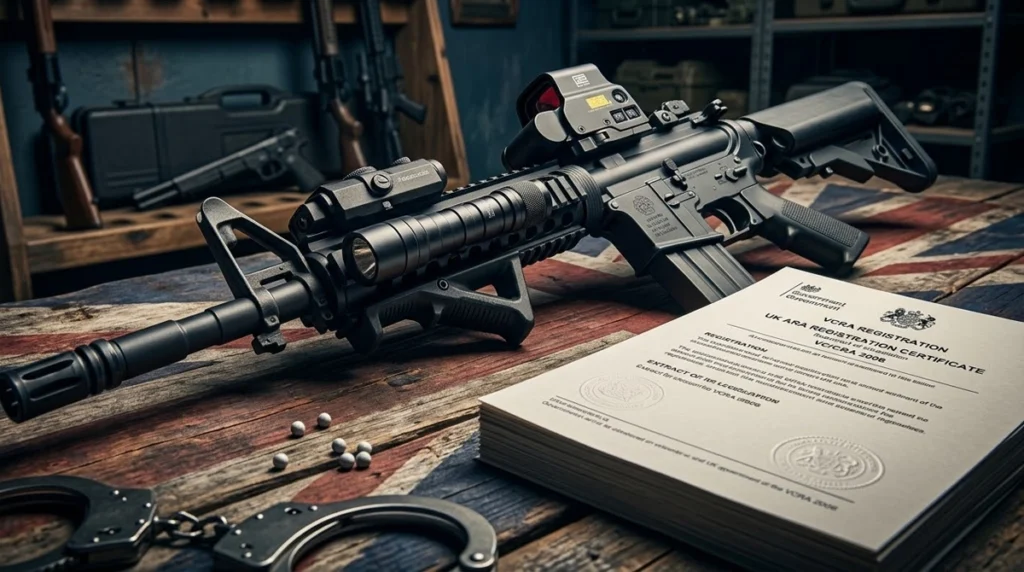
A: Yes. In fact, many dedicated Action Air clubs can act as your Parent Site for a UKARA defense. Because the sport requires Realistic Imitation Firearms (RIFs), being an active UKPSA member is one of the strongest defenses you can have for owning high-end tactical replicas.
Q: Can I use a regular airsoft gun for Action Air?
A: Technically yes, as long as it is a Gas Blowback (GBB) pistol that meets the 1.3 Joule limit. However, most serious competitors use Race Guns pistols tuned for a 2lb trigger pull and high-cycle speed.
Q: Where can I find Action Air matches in 2026?
A: The UKPSA Match Calendar is the central hub. Major centers include The Range in London, several dedicated IPSC halls in the Midlands, and the thriving Recoil Scotland circuit.
Q: Does Action Air have a Rifle category?
A: Yes! As of January 2026, Action Air Rifle has officially launched as a standalone discipline. It uses GBB M4 and AK platforms for carbine-style stages, perfect for those wanting to practice short-range tactical rifle work.
Q: How do I get started?
A: Most clubs offer a Safety Induction or a Safety Training Course (STC). This is mandatory before you can compete in a sanctioned match. It covers the rules, the range commands, and the 180-degree muzzle awareness.
Conclusion: The pro’s path to performance
In the 2026 UK shooting landscape, IPSC Action Air is the ultimate “Performance Multiplier.” It strips away the cost and the legal baggage of real firearms and replaces them with a pure, adrenaline-fueled competitive experience. Whether you are training for a future FAC or just want to be the fastest shooter on the range, the path to tactical mastery starts on the UKPSA circuit.